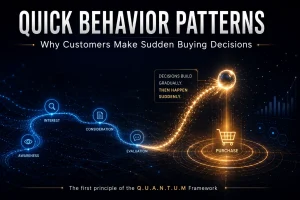
The physics-inspired framework reshaping modern strategy
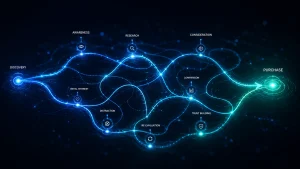
Forget the funnel. Forget the illusion of linearity. Marketing is not a straight path. It’s a quantum system.
Introduction
We live in a nonlinear world.
Customers don’t move in straight lines.
They don’t make decisions like machines.
And traditional marketing models — rigid funnels, fixed segments, and one-size-fits-all strategies — are collapsing under the complexity of real human behavior.
That’s why we need a new way of thinking.
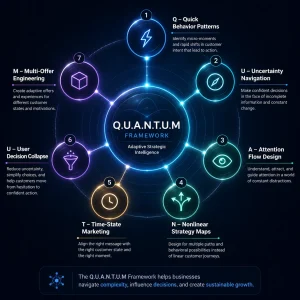
Let me introduce you to Quantum Marketing — a model inspired by modern physics, designed to decode uncertainty, behavior, and movement in today’s markets.
What is Quantum Marketing?
Quantum Marketing is a conceptual and strategic framework that borrows from quantum physics, statistical mechanics, and modern behavioral theory to analyze and guide marketing decisions in a dynamic, uncertain environment.
It doesn’t treat the customer as a number.
It treats them as a moving particle — with velocity, momentum, energy, and unpredictability.
It’s not about predicting behavior.
It’s about preparing for possibility.
Key Concepts of Quantum Marketing
1. Uncertainty (Heisenberg’s Principle)
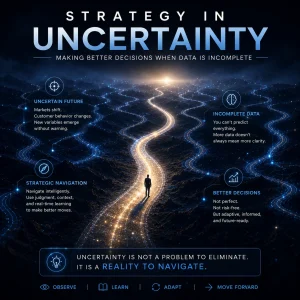
You can’t fully predict both what a customer will do and when they’ll do it. The more you try to fix one, the more the other slips away.
That’s not bad. It’s natural.
Quantum Marketing teaches you to work with uncertainty, not fight it.
2. Observer Effect
Just by tracking customer behavior — via analytics, heatmaps, cookies — you’re already affecting that behavior.
This means data is not neutral.
The act of measuring changes the outcome.
Smart marketers learn how to interpret this interference.
3. Resonance
Customers don’t always choose based on logic.
They “resonate” with a brand that feels right.
Quantum Marketing views a brand as a wave — a frequency.
If that frequency matches the customer’s internal frequency (values, desires, mindset), resonance happens.
This leads to loyalty, not just conversion.
4. Fields & Forces
Brands create invisible “fields” — just like gravitational or magnetic fields — that attract or repel.
A stronger brand has more “mass” (credibility, presence, relevance) and pulls customers in without shouting.
5. Half-Life of a Brand
Brands, like radioactive elements, decay over time.
If you don’t refresh your brand’s energy — with content, experiences, touchpoints — your presence fades.
You must constantly “inject energy” to keep your brand alive.
6. Motion-Based Funnels
Don’t measure just clicks or views.
Track movement.
Where do users slow down? Accelerate? Bounce?
Map their behavior like a kinetic diagram.
This gives you real insight, not just metrics.
7. Statistical Modeling
Quantum Marketing embraces probability instead of false precision.
It’s not about “everyone will do X.”
It’s about “40% of users tend to move from this page to checkout when Y happens.”
And that’s powerful.
Why Does It Matter?
Because the world has changed.
- Attention spans are shorter.
- Decision paths are complex.
- Content is infinite.
- Trust is fragile.
Quantum Marketing gives you a fluid, adaptive, data-driven way to think about customers — not as users, but as participants in a system you influence, but don’t control.
What Can You Do with It?
Re-design your funnel as a flexible flow
Build content that resonates — not just reaches
Predict behavior probabilistically, not absolutely
Increase conversions by responding in real time to change, not averages
Who Created This Model?
Quantum Marketing was developed by Mohammad Ganji, a physicist turned marketing strategist, with over 30 years of experience teaching physics and a decade of consulting for major educational brands and institutions in Iran.
Combining the precision of science with the fluidity of human behavior, this model bridges the gap between data and emotion, measurement and motion, signal and noise.
Final Thought
“Marketing is not a funnel. It’s a field.
And your job is to understand its energy, not just its endpoints.”