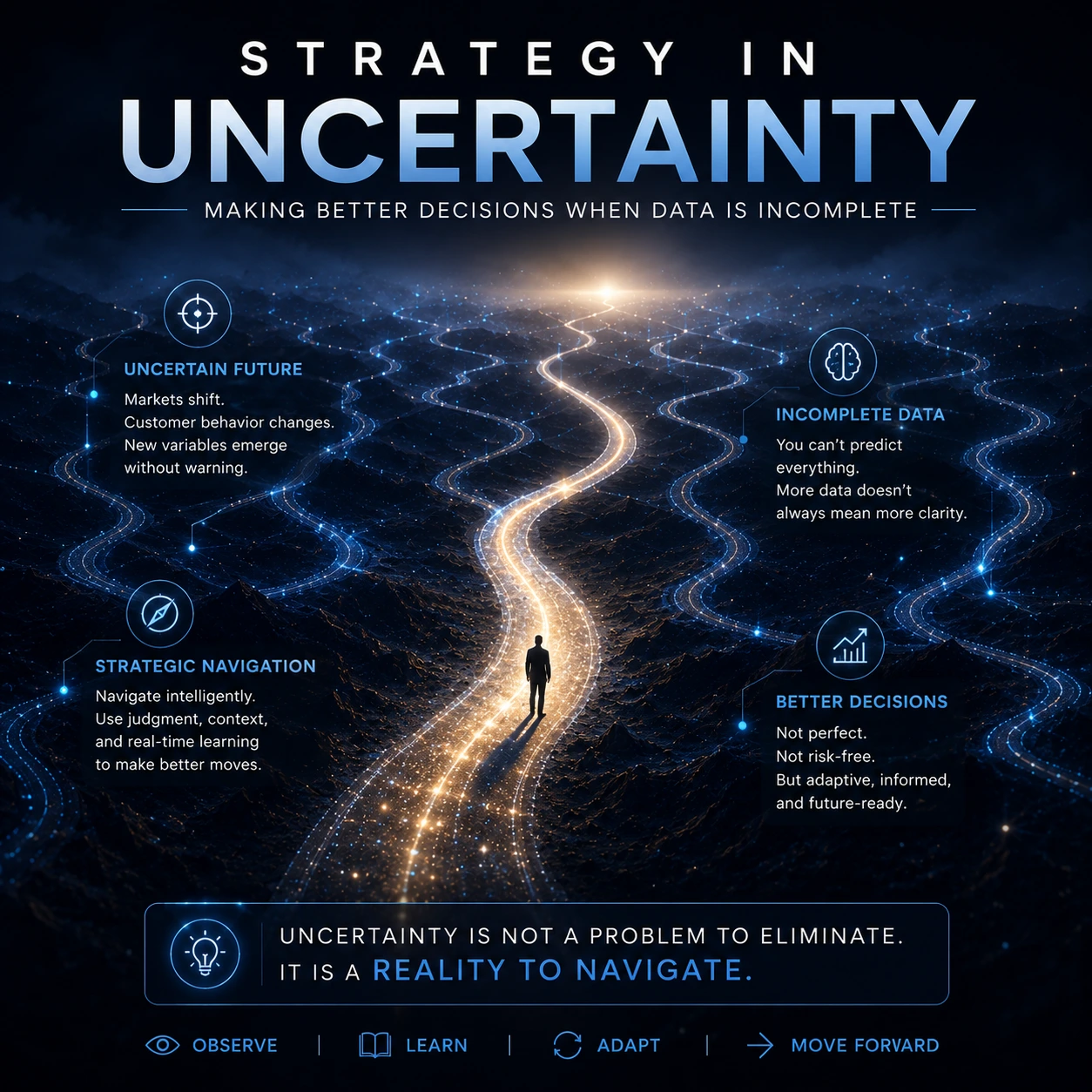
Strategy in Uncertainty, Learn how to make better strategic decisions when markets are uncertain, customer behavior is unpredictable, and data is incomplete.
Why Waiting for Perfect Information Is the Worst Strategy
Every leader wants certainty.
Every marketer wants perfect data.
Every business wants predictable results.
Unfortunately, modern markets offer none of these.
Customer expectations shift.
Technology evolves.
Competitors react.
Economic conditions change.
Algorithms are updated.
Consumer attention moves faster than ever.
Yet many organizations continue searching for something that rarely exists:
Complete certainty before making a decision.
Ironically, waiting for certainty often becomes the greatest source of strategic failure.
Uncertainty Is Not the Enemy
For decades, businesses tried to eliminate uncertainty.
Forecast more.
Collect more data.
Build larger reports.
Run more research.
These activities are valuable.
But they cannot eliminate uncertainty.
Because uncertainty is not simply missing information.
It is an inherent characteristic of complex systems.
Modern markets behave as complex adaptive systems.
Small events can create large consequences.
Unexpected competitors emerge.
Consumer preferences shift overnight.
No spreadsheet can fully predict that.
Why Traditional Planning Often Breaks Down
Most strategic planning assumes stability.
The market is expected to remain relatively consistent.
Inputs remain predictable.
Competitors behave rationally.
Customers follow recognizable patterns.
Reality is different.
A single viral video can reshape demand.
A technological innovation can change an entire industry.
One unexpected event can invalidate months of planning.
The problem isn’t poor planning.
The problem is planning for a world that no longer exists.
The Illusion of Complete Data
Organizations often believe that better dashboards automatically produce better decisions.
They don’t.
Data tells us what happened.
Sometimes it suggests why.
Rarely does it tell us exactly what will happen next.
Historical data always describes yesterday.
Strategy exists to prepare for tomorrow.
That gap can never be filled by data alone.
Judgment remains essential.
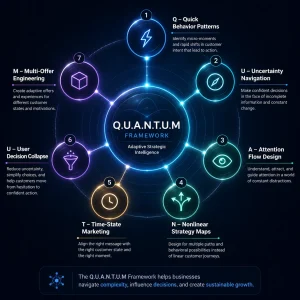
The Q.U.A.N.T.U.M Perspective
Within the Q.U.A.N.T.U.M Framework, uncertainty is not treated as a weakness.
It is treated as the normal operating environment.
This principle is represented by:
U — Uncertainty Navigation
Instead of trying to eliminate uncertainty, organizations develop the capability to navigate through it.
That requires:
- continuous learning
- adaptive planning
- flexible execution
- rapid feedback
- intelligent observation
Strategy becomes navigation rather than prediction.
Great Businesses Navigate
Consider how successful organizations behave.
They rarely wait until every answer is available.
Instead they:
launch small experiments
observe customer behavior
learn quickly
adapt continuously
improve through feedback
They move.
Then adjust.
Not the other way around.
Strategic Decisions Are Probabilistic
Many executives ask:
“What is the right decision?”
A better question is:
“What decision gives us the highest probability of success with the information currently available?”
This shift changes everything.
Instead of seeking certainty, leaders evaluate probabilities.
Instead of rigid plans, they design adaptable systems.
Instead of defending assumptions, they update them.
Adaptive Strategy Beats Perfect Planning
Traditional strategy often focuses on building the perfect roadmap.
Adaptive strategy focuses on building organizations capable of changing direction.
This includes:
multiple scenarios
flexible resource allocation
continuous measurement
rapid experimentation
iterative improvement
The goal is resilience.
Not perfection.
Why This Matters in Marketing
Marketing is one of the most uncertain business functions.
Customer preferences evolve.
Platforms change.
Advertising costs fluctuate.
Competitors react instantly.
Campaign performance changes daily.
Success no longer comes from predicting every outcome.
It comes from building systems capable of learning faster than competitors.
A Practical Decision Framework
When facing uncertainty, ask five questions.
What do we know?
Separate facts from assumptions.
What do we not know?
Identify the uncertainties instead of ignoring them.
What can we test quickly?
Replace debate with experimentation.
What is the downside?
Understand acceptable risk before acting.
What can we learn next?
Every decision should generate information.
Learning becomes a strategic asset.
The Future Belongs to Adaptive Thinkers
Business history consistently rewards organizations that adapt.
Not those that predict perfectly.
The future will always contain uncertainty.
Markets will remain dynamic.
Customer behavior will continue evolving.
The competitive advantage will belong to organizations capable of making intelligent decisions without waiting for perfect certainty.
Final Thought
Strategy has never been about predicting the future.
It has always been about preparing for multiple possible futures.
The organizations that succeed are not those with the most certainty.
They are the ones that learn, adapt, and move with confidence despite uncertainty.
That is the essence of modern strategic thinking.
And it is one of the foundations of Quantum Marketing.