The Q.U.A.N.T.U.M Framework Explained: Seven Dimensions of Modern Marketing Strategy.
The Q.U.A.N.T.U.M Framework Explained
A Strategic Operating System for Modern Markets
Most marketing frameworks were designed for a world that was more predictable than the one we face today.
Markets were simpler.
Customer journeys were clearer.
Competition moved more slowly.
Today, businesses operate in a very different environment.
Customers change direction unexpectedly.
Attention shifts constantly.
Data provides signals but rarely complete certainty.
Buying decisions emerge through complex interactions rather than simple linear processes.
The challenge is no longer finding a perfect formula.
The challenge is building a system that can operate effectively within uncertainty.
That challenge led to the development of the Q.U.A.N.T.U.M Framework.
What Is the Q.U.A.N.T.U.M Framework?
The Q.U.A.N.T.U.M Framework is the strategic foundation of Quantum Marketing.
It is designed to help businesses understand customer behavior, design adaptive strategies, and make better decisions in dynamic environments.
Rather than viewing marketing as a sequence of isolated activities, the framework treats marketing as a living system composed of interconnected behaviors, decisions, signals, and feedback loops.
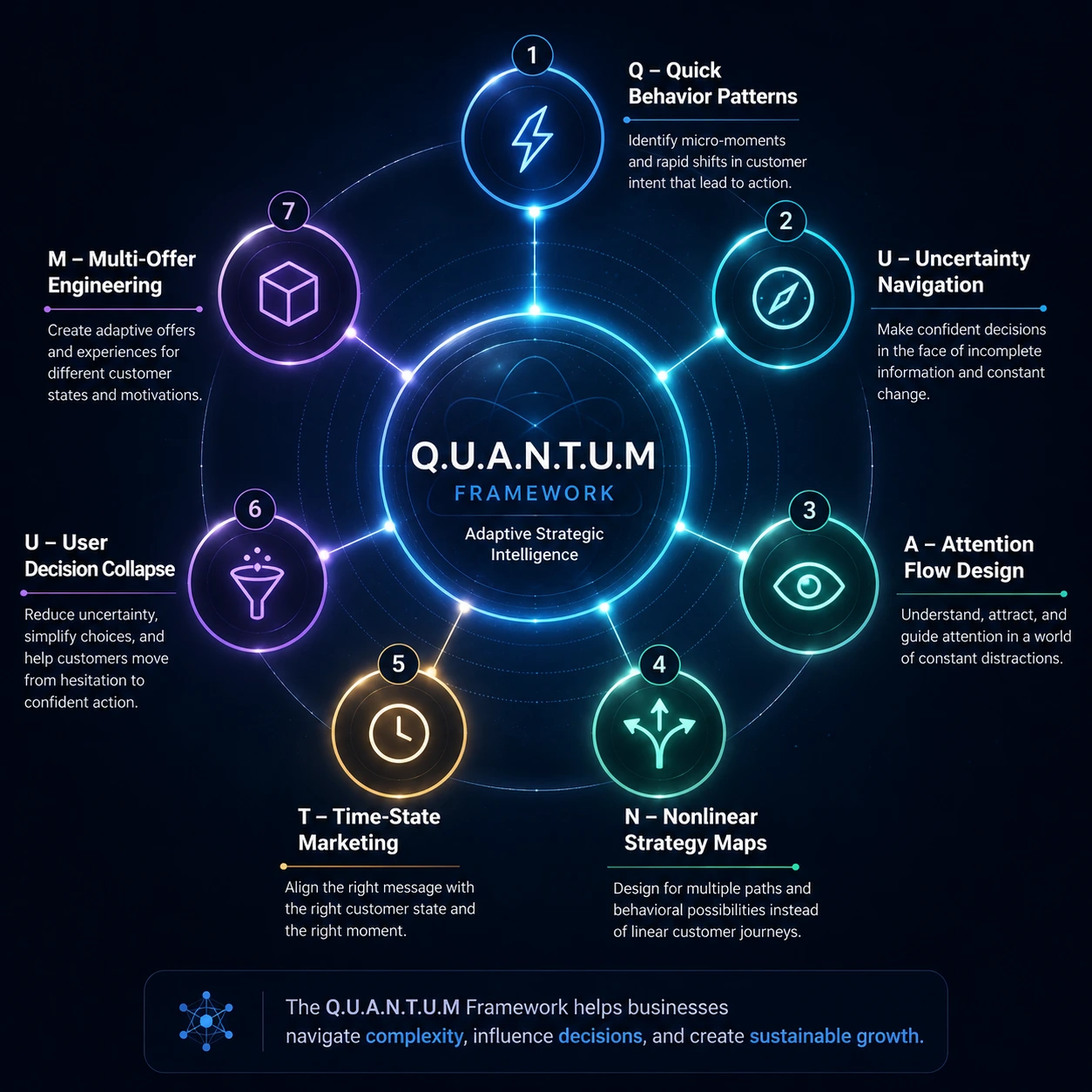
Each letter in Q.U.A.N.T.U.M represents a critical dimension of modern strategy.
Together, they form an integrated operating model for navigating complexity.
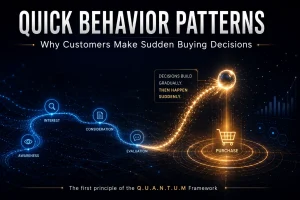
Q — Quick Behavior Patterns
Understanding Moments of Sudden Change
One of the biggest misconceptions in marketing is the belief that customer decisions happen gradually.
In reality, customers often move through long periods of observation followed by rapid moments of action.
A prospect may spend weeks researching options and then make a decision in minutes.
The challenge for marketers is identifying and preparing for these decision moments.
Quick Behavior Patterns focus on:
- identifying decision triggers
- recognizing shifts in customer intent
- designing campaigns for rapid action
- reducing friction at critical moments
The goal is not to predict every decision.
The goal is to be present when decisions happen.
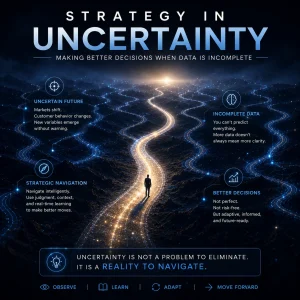
U — Uncertainty Navigation
Making Better Decisions Without Perfect Information
Every business wants certainty.
Few businesses actually have it.
Customer needs evolve.
Competitors change.
Technology advances.
Market conditions shift.
Waiting for complete information often means acting too late.
Uncertainty Navigation focuses on:
- decision-making under ambiguity
- adaptive planning
- strategic flexibility
- scenario-based thinking
Successful organizations do not eliminate uncertainty.
They learn how to navigate through it.
A — Attention Flow Design
Managing the Most Valuable Resource in Modern Markets
Attention has become one of the most competitive resources in business.
The challenge is no longer visibility.
The challenge is maintaining meaningful attention long enough to create engagement and action.
Attention Flow Design examines:
- how attention moves
- where attention gets lost
- what captures interest
- how attention converts into decisions
Instead of treating attention as a static metric, the framework views it as a dynamic flow that can be influenced and directed.
N — Nonlinear Strategy Maps
Designing for Multiple Customer Journeys
Traditional marketing assumes customers follow predictable paths.
Modern customers rarely do.
One customer may discover a brand through search.
Another through social media.
A third through referrals.
A fourth may engage repeatedly for months before acting.
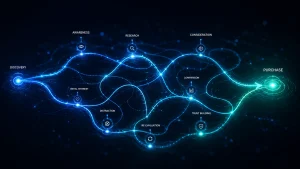
Nonlinear Strategy Maps recognize that there is no single customer journey.
They focus on:
- multiple entry points
- alternative conversion paths
- behavioral flexibility
- adaptive customer experiences
The objective is not controlling the path.
It is designing systems that perform across many possible paths.
T — Time-State Marketing
Why Timing Changes Everything
A great message delivered at the wrong moment often fails.
An average message delivered at the right moment can succeed.
Time-State Marketing focuses on understanding the relationship between:
- customer readiness
- market timing
- contextual relevance
- decision windows
Customers move through different states of awareness, interest, evaluation, and commitment.
Effective marketing aligns communication with those states.
Timing is not simply scheduling.
Timing is strategy.
U — User Decision Collapse
Transforming Uncertainty Into Commitment
Customers often exist in a state of uncertainty.
They compare options.
Evaluate risks.
Delay decisions.
The role of marketing is not to pressure customers.
The role is to create clarity.
User Decision Collapse focuses on:
- reducing ambiguity
- increasing confidence
- simplifying choices
- supporting commitment
The moment of decision occurs when uncertainty becomes manageable.
Strong brands help customers reach that point faster.
M — Multi-Offer Engineering
Building Value for Different Customer States
Not every customer values the same thing.
Different people have different priorities, concerns, motivations, and decision criteria.
A single offer rarely serves every audience effectively.
Multi-Offer Engineering focuses on:
- adaptive value propositions
- customer segmentation through behavior
- offer architecture
- personalized pathways
Rather than forcing customers into one solution, businesses create multiple pathways toward value.
Why the Framework Matters
The Q.U.A.N.T.U.M Framework was created to address a reality many organizations experience every day:
Markets are becoming more complex.
Customer behavior is becoming less predictable.
Competition is accelerating.
Traditional models still provide value, but they often struggle to explain the full dynamics of modern decision-making.
The Q.U.A.N.T.U.M Framework offers a different perspective.
One that embraces complexity rather than avoiding it.
How the Framework Works in Practice
Organizations can apply the framework to:
Marketing Strategy
Design adaptive growth strategies for uncertain environments.
Customer Experience
Understand how people move between different decision states.
Campaign Design
Align messages with attention, timing, and readiness.
Brand Development
Create stronger attraction mechanisms and long-term engagement.
Business Growth
Develop systems capable of adapting to changing market conditions.
Beyond Marketing: A Strategic Lens
Although the framework originated within marketing, its applications extend beyond marketing activities alone.
The principles can also support:
- business strategy
- innovation planning
- customer experience design
- growth systems
- organizational decision-making
Because uncertainty is not a marketing problem.
It is a business reality.
The Future of Strategy
The future will not belong to organizations that attempt to predict everything.
It will belong to organizations that can:
- observe effectively
- adapt rapidly
- learn continuously
- make decisions despite uncertainty
The Q.U.A.N.T.U.M Framework was created for that future.
Not as a rigid methodology.
But as a strategic operating system for navigating complexity.
Strategy is no longer about certainty.
Strategy is about intelligent adaptation.