Customer Behavior Is Nonlinear: Why Buying Decisions Are Not Predictable.Discover why customer behavior is nonlinear and why modern buying decisions rarely follow predictable paths. Learn how businesses can adapt to complex customer journeys.
The Biggest Myth in Marketing
Many marketing strategies are built on a simple assumption:
Customers move through a predictable journey.
They discover a product.
They become interested.
They evaluate options.
They make a purchase.
Simple.
Logical.
Predictable.
Unfortunately, real customers rarely behave this way.
Modern buying behavior is messy, emotional, dynamic, and often completely unexpected.
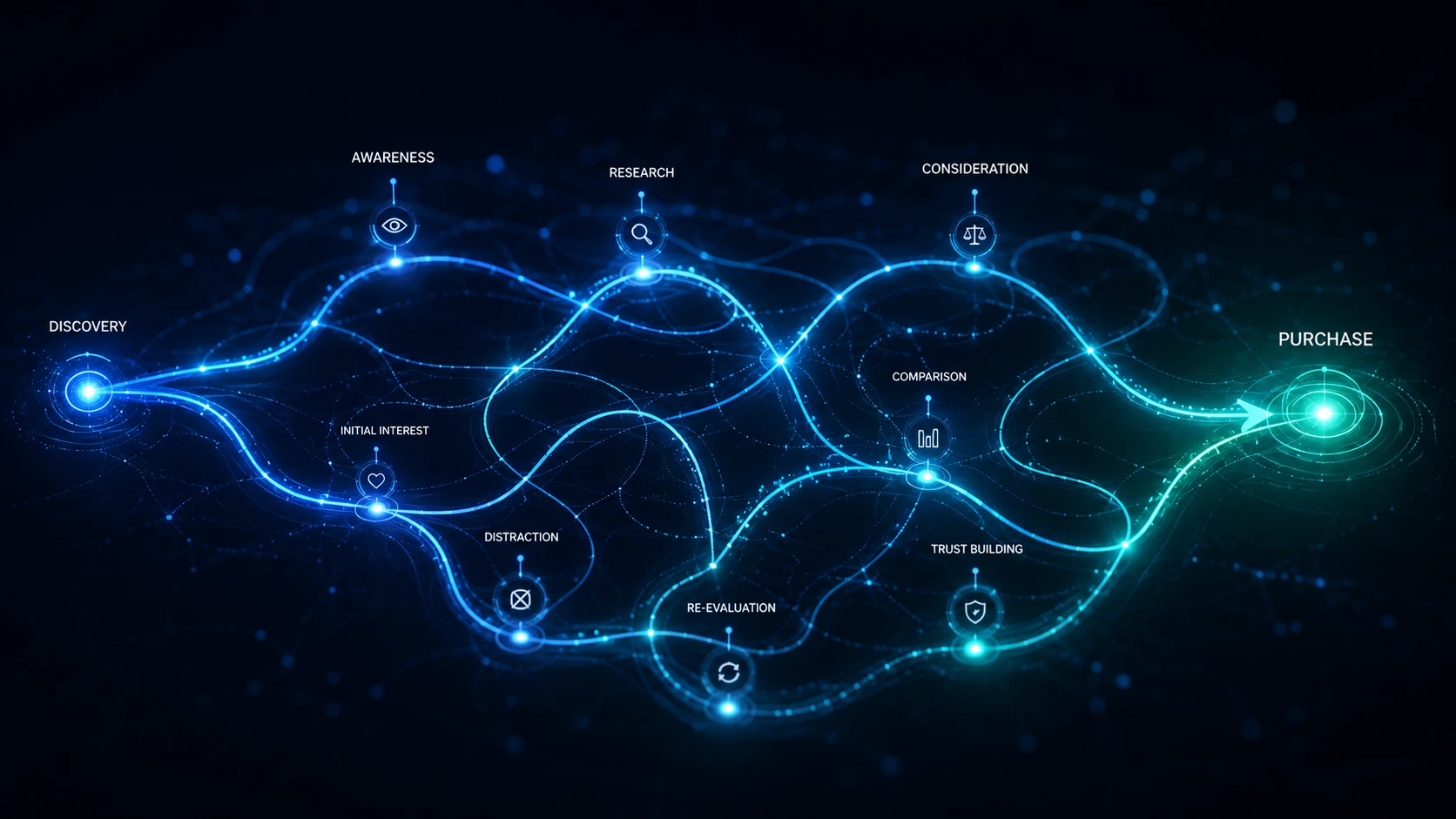
The reality is that customer behavior is nonlinear.
And understanding this fact may be one of the most important competitive advantages a business can develop.
The Problem With Linear Thinking
Traditional marketing frameworks often visualize customer journeys as funnels.
Awareness → Interest → Consideration → Purchase
While useful as simplified models, these frameworks can create dangerous assumptions.
They suggest that customers move step by step toward a purchase.
Real behavior tells a different story.
Customers:
- leave and return
- compare multiple brands simultaneously
- switch priorities unexpectedly
- pause decisions for weeks or months
- enter the journey from different points
The path is rarely straight.
A Real Customer Journey
Imagine a potential customer discovering your business.
Day 1:
They find your website through Google.
Day 3:
They visit your LinkedIn profile.
Day 10:
They read a blog article.
Day 17:
They watch one of your videos.
Day 30:
Nothing happens.
Day 52:
A colleague mentions your brand.
Day 55:
They return to your website.
Day 56:
They become a customer.
Which touchpoint caused the purchase?
The answer is often impossible to know with certainty.
The purchase emerged from the interaction of multiple influences over time.
This is nonlinear behavior.
Why Customer Decisions Are Difficult to Predict
Many businesses believe more data automatically leads to better predictions.
Data helps.
But human behavior remains complex.
Several factors contribute to unpredictability:
Changing Priorities
Customers constantly reevaluate what matters to them.
What feels urgent today may feel irrelevant tomorrow.
Context Matters
The same offer can produce different results depending on:
- timing
- emotional state
- financial conditions
- competing priorities
Context changes decisions.
Multiple Influences Interact Simultaneously
Customers rarely respond to a single message.
Instead, they are influenced by:
- advertising
- social proof
- recommendations
- previous experiences
- content
- timing
These influences interact continuously.
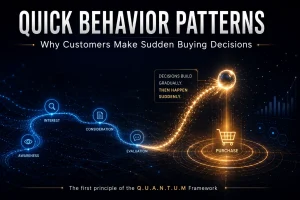
Decisions Often Happen Suddenly
People frequently spend long periods researching and then make rapid decisions.
The visible action appears sudden.
The underlying process may have been developing for weeks.
The Nonlinear Strategy Principle
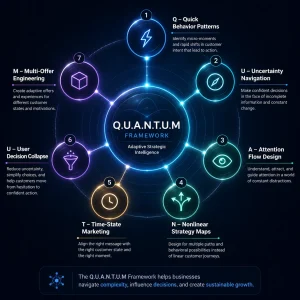
Within the Q.U.A.N.T.U.M Framework, this concept is represented by:
N — Nonlinear Strategy
The principle is simple:
Customer journeys should not be treated as fixed sequences.
Instead, businesses should design systems capable of supporting multiple paths.
A nonlinear strategy assumes:
- customers enter from different channels
- customers move at different speeds
- customers require different information
- customers make decisions through unique journeys
The objective is flexibility rather than control.
Why Funnels Are No Longer Enough
Funnels remain useful.
But they are incomplete.
A funnel shows a simplified flow.
Modern customer behavior resembles a network.
Customers move:
- forward
- backward
- sideways
- repeatedly
The journey is less like a pipeline and more like a dynamic ecosystem.
This shift changes how businesses should think about marketing.
How Successful Brands Adapt
Organizations that understand nonlinear behavior tend to focus on several key principles.
Multiple Entry Points
Customers should be able to discover the brand through different channels.
Search.
Content.
Social media.
Referrals.
Partnerships.
Every entry point matters.
Consistent Brand Signals
Because customers encounter brands at different moments, consistency becomes critical.
Messages may be consumed weeks apart.
Consistency creates recognition.
Recognition creates trust.
Adaptive Customer Experiences
Different customers require different journeys.
Some want detailed information.
Others want quick answers.
Some need proof.
Others need reassurance.
Adaptive experiences outperform rigid pathways.
Long-Term Relationship Building
Nonlinear behavior means many customers are not ready immediately.
The goal is not simply generating attention.
The goal is remaining relevant until the customer is ready.
The Hidden Opportunity
Many businesses become frustrated when customers fail to convert immediately.
But nonlinear behavior reveals a different perspective.
A customer who leaves today is not necessarily lost.
A customer who ignores an offer may return later.
A prospect who appears inactive may still be progressing internally.
The challenge is maintaining visibility without becoming intrusive.
What Quantum Marketing Adds
Traditional marketing asks:
“Where is the customer in the funnel?”
Quantum Marketing asks:
“Which behavioral state is the customer currently experiencing?”
This is a significant difference.
Instead of assuming a fixed path, the framework recognizes multiple possible paths existing simultaneously.
The goal becomes understanding movement rather than predicting exact outcomes.
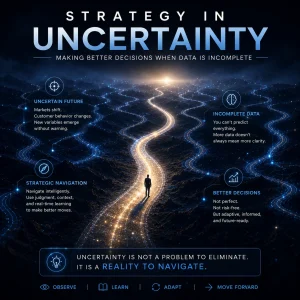
Strategy for an Unpredictable Market
Markets are becoming increasingly complex.
Customers have more information.
More options.
More distractions.
As complexity increases, the ability to understand nonlinear behavior becomes increasingly valuable.
Organizations that continue relying on rigid customer journey assumptions risk misunderstanding how modern decisions actually happen.
Organizations that embrace complexity gain a more realistic view of customer behavior.
And realistic models create better strategies.
Final Thought
Customers are not machines.
They do not follow scripts.
They do not move through perfectly designed funnels.
Human decisions emerge through dynamic interactions, changing priorities, and unpredictable moments.
That is not a problem to eliminate.
It is a reality to understand.
The future of marketing belongs to businesses that design for movement, adaptation, and complexity.
Not certainty.