Why Traditional Marketing Is No Longer Enough
For decades, marketing was built around predictability.
Businesses segmented customers, created campaigns, selected channels, and expected measurable outcomes. The process was relatively straightforward because customer journeys were simpler and market conditions changed more slowly.
Today, that reality has changed.
Customers interact with dozens of touchpoints before making decisions. They compare options, consume content across multiple platforms, and often change direction unexpectedly. Markets evolve rapidly, attention spans are fragmented, and competition is constant.
As complexity increases, many businesses find themselves asking a difficult question:
Why do traditional marketing models explain less and less of what customers actually do?
This question led to the development of Quantum Marketing.
What Is Quantum Marketing?
Quantum Marketing is a strategic framework designed to understand customer behavior in uncertain, dynamic, and nonlinear environments.
Rather than assuming that customers follow predictable paths, Quantum Marketing recognizes that human decisions are influenced by multiple factors simultaneously:
- context
- timing
- attention
- perception
- trust
- competing alternatives
- environmental signals
The framework draws inspiration from concepts found in modern physics and complexity thinking, using them as strategic lenses for understanding how people make decisions in real-world markets.
It is not about applying physics equations to marketing.
It is about adopting a more adaptive way of thinking.
Why the Word “Quantum”?
The word quantum often creates confusion.
Many people associate it exclusively with physics, subatomic particles, or scientific theory.
In Quantum Marketing, the term represents something broader:
A recognition that markets often behave in ways that are:
- uncertain
- interconnected
- dynamic
- difficult to predict with complete accuracy
Just as modern physics challenged older assumptions about certainty and predictability, modern markets challenge traditional assumptions about customer behavior.
The name reflects that shift in perspective.
The Limits of Linear Marketing
Many traditional frameworks assume that customers move through a sequence:
Awareness → Interest → Desire → Action
Sometimes they do.
Often they do not.
A customer may:
- discover a brand through social media
- leave without engaging
- encounter the brand again through search
- read several articles weeks later
- receive a recommendation from a friend
- make a purchase months after the first interaction
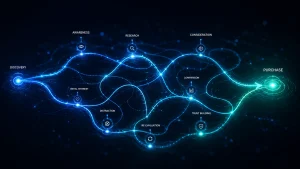
The journey is rarely linear.
Modern marketing requires models that can accommodate multiple paths and changing conditions.
The Core Principles of Quantum Marketing
1. Uncertainty Is Normal
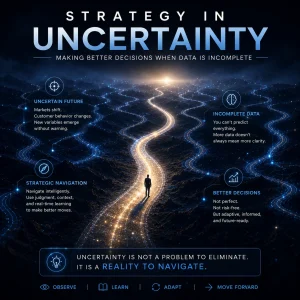
Businesses often seek certainty before taking action.
Quantum Marketing assumes that uncertainty is unavoidable.
The goal is not to eliminate uncertainty.
The goal is to make better decisions despite it.
2. Customer Behavior Is Dynamic
Customers are constantly influenced by new information, experiences, and environmental changes.
What worked yesterday may not work tomorrow.
Strategies must evolve accordingly.
3. Attention Is a Moving Target
Attention is one of the most valuable resources in modern business.
Understanding how attention moves and changes is often more important than simply generating visibility.
4. Decisions Are Contextual
Customers rarely evaluate products in isolation.
The same offer can produce different outcomes depending on timing, emotional state, perceived risk, and surrounding conditions.
5. Strategy Must Be Adaptive
Rigid plans struggle in complex markets.
Successful businesses build systems capable of learning, adjusting, and responding to change.
The Q.U.A.N.T.U.M Framework
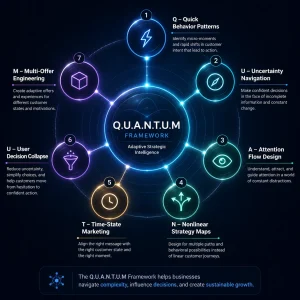
To make these ideas practical, Quantum Marketing is organized through the Q.U.A.N.T.U.M Framework.
The framework includes seven interconnected dimensions:
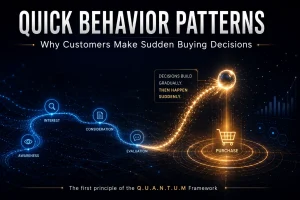
Q — Quick Behavior Patterns
Recognizing rapid shifts in customer intent.
U — Uncertainty Navigation
Making decisions when information is incomplete.
A — Attention Flow Design
Understanding and guiding customer attention.
N — Nonlinear Strategy Maps
Designing for multiple customer journeys.
T — Time-State Marketing
Aligning messages with timing and customer readiness.
U — User Decision Collapse
Reducing uncertainty and helping customers commit.
M — Multi-Offer Engineering
Creating adaptive value propositions for different customer states.
Together, these elements create a practical operating system for modern marketing strategy.
Is Quantum Marketing a Theory or a Practical Framework?
One of the most common questions is whether Quantum Marketing is simply a conceptual idea.
The answer is no.
The framework was developed to address real business challenges, including:
- customer acquisition
- campaign design
- conversion optimization
- brand development
- customer retention
- strategic decision-making
Its purpose is practical application, not theoretical discussion.
Who Can Benefit From Quantum Marketing?
Quantum Marketing can be useful for:
- founders
- entrepreneurs
- marketing leaders
- consultants
- growth teams
- business strategists
Anyone operating in complex and uncertain markets can benefit from a more adaptive approach to strategy.
Looking Ahead
Markets will continue to become more connected, more dynamic, and more unpredictable.
The challenge is no longer simply reaching customers.
The challenge is understanding how decisions emerge within complex systems.
Quantum Marketing represents one possible answer to that challenge.
It is not a replacement for marketing fundamentals.
It is a framework for navigating uncertainty, understanding customer behavior, and building strategies that adapt to change.
The future of marketing may not be more certainty.
It may be better navigation through uncertainty